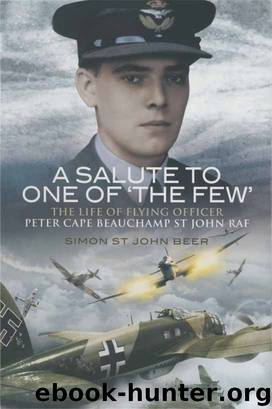
A Salute to One of 'the Few' by Simon St. John Beer
Author:Simon St. John Beer
Language: eng
Format: epub
ISBN: 9781473817920
Publisher: Pen & Sword Books
CHAPTER NINE
74 Squadron
There are decades when nothing happens;
and there are weeks when decades happen.
Lenin
Hornchurch aerodrome, east of London, just above the Thames estuary, is now the most renowned Spitfire aerodrome in Fighter Command. The approach path flies right over the Ford factory at Dagenham. Peter’s been here before. Was it 1935 or 1936? He had come to one of the Empire Air Days with John Boughton, not long after its name had been changed from Sutton’s Farm to RAF Hornchurch.
Here, in February 1939, 74 Squadron, Tiger Squadron (his new Squadron) had been equipped with Spitfires.
Now Hornchurch is a sector station in No. 11 Group of Fighter Command. From here, Peter and his colleagues will guard the south-east approaches to London. The airfield is all grass. It has three defined runways, the longest 1,200 yards and the other two 850 and 830 yards. There are three large ‘C’ type hangars, and a six-yard wide perimeter track surrounding the field. Three of Fighter Command’s twelve squadrons are based on this airfield. In the early thirties, 54 and 65 Squadrons had been re-formed at Hornchurch and 74 Squadron has been based at the airfield since it returned from Malta in 1936. In order to handle all the Spitfires, as well as visiting aircraft, Hornchurch now has two satellite airfields, one at Rochford and another at Manston.
RAF Hornchurch has pioneered new techniques in expediting aircraft movements. In the early days of the war, aircraft had been widely dispersed around the airfield to protect them from enemy air strikes, the lessons of Poland, where most of their Air Force had been destroyed on the ground, being quickly learned. Informing air and ground crews of the controller’s intentions quickly is difficult, because of the large physical distances involved. A broadcasting system has been installed to enable the controller’s instructions to reach the dispersal areas and huts. It has proved such a success that it is introduced to all the other RAF stations. The company that installed this audio system is called ‘Tannoy’ and the name has become synonymous with all military public address systems.
It was from Hornchurch that one of the first wartime interceptions took place. Hurricanes of 56 Squadron had taken off from North Weald to counter an apparent enemy force approaching from the coast. At seven o’clock on the very foggy morning of 6 September 1939, six Spitfires of 74 Squadron had been scrambled to investigate some unidentified aircraft making for Harwich. Three Spitfires, Red Section of ‘A’ Flight, led by ‘Sailor’ Malan, got away first. These were followed a little later by three more Spitfires, Yellow Section of ‘A’ Flight, commanded by Paddy Byrne as Yellow 1, with John Freeborn as his Yellow 2, and Sergeant ‘Polly’ Flinders as Yellow 3. Ground fog reduced visibility to 20 yards but overhead, clear blue early autumn sky could be seen. Yellow Section had to climb hard to catch Red Section, their take-off having been delayed because of problems with Byrne’s aircraft. In these early days of the war, everybody is cautious, expecting trouble.
Download
This site does not store any files on its server. We only index and link to content provided by other sites. Please contact the content providers to delete copyright contents if any and email us, we'll remove relevant links or contents immediately.
Fanny Burney by Claire Harman(26607)
Empire of the Sikhs by Patwant Singh(23090)
Out of India by Michael Foss(16861)
Leonardo da Vinci by Walter Isaacson(13342)
Small Great Things by Jodi Picoult(7156)
The Six Wives Of Henry VIII (WOMEN IN HISTORY) by Fraser Antonia(5519)
The Wind in My Hair by Masih Alinejad(5104)
A Higher Loyalty: Truth, Lies, and Leadership by James Comey(4967)
The Crown by Robert Lacey(4821)
The Lonely City by Olivia Laing(4808)
Millionaire: The Philanderer, Gambler, and Duelist Who Invented Modern Finance by Janet Gleeson(4483)
The Iron Duke by The Iron Duke(4367)
Papillon (English) by Henri Charrière(4278)
Sticky Fingers by Joe Hagan(4208)
Joan of Arc by Mary Gordon(4119)
Alive: The Story of the Andes Survivors by Piers Paul Read(4037)
Stalin by Stephen Kotkin(3973)
Aleister Crowley: The Biography by Tobias Churton(3647)
Ants Among Elephants by Sujatha Gidla(3472)
